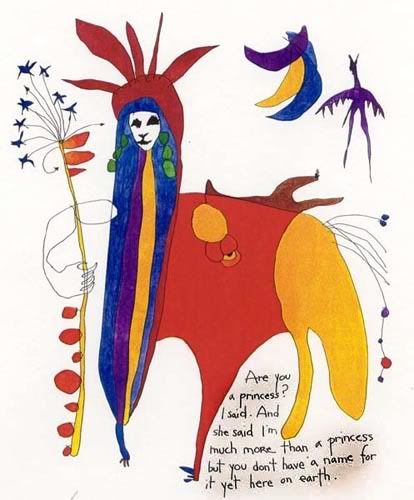
Taken from Maya
25 Reasons to Keep Writing
1. Because sometimes metaphors work better than just words
2. Angst makes me feel alive
3. Impossible yearning is the most powerful feeling of all
4. Drugs are expensive
5. I like infinity, and combinations of letters are endless
6. Because I am a gateway to the Land of Unwritten Ideas
7. I like feeling important
8. I like laughing at typos
9. I want to remember everything
10. Because sometimes you just have to escape
11. Because sometimes no one can tell the story better
12. Characters are counting on me
13. Friends are counting on me
14. The what-ifs are more entertaining
15. Absolute omnipotence and power
16. There is nothing else
17. I’m bored
18. Keyboards make funny sounds
19. Dreams are more realistic anyway
20. To educate the world on the importance of cats over men
21. Everything sounds better in poetic format
22. Because being brainless is overrated
23. Cause people fear you easier
24. It helps with the loneliness
25. The electric possibility of getting it right, and the smaller, quiet beauty of almost.
Thursday, November 23, 2006


Saturday, November 18, 2006
So you wanna be a writer?
All right. It's time to buckle down and get on it.
Introduction to Publishing:
1) Write a good piece. Don't roll your eyes at me; this is a vital step. So far all we've talked about is the writing process. You should have that down by now. So don't forget this step.
2) Research. You want to start submitting your pieces. Okay. Where do you submit them? You should submit them to a literary magazine.
What literary magazine? How do I find out about literary magazines? You're in luck. I have a website for you: Click here!
the above is a comprehensive list of literary magazines that welcome submissions. Now we have to get into the tricky stuff.
Why research? you say. You should be able to find the 'submissions' page pretty easily on any literary magazine site. VERY CAREFULLY read their requirements. If you do not conform to what the magazine wants you to do, they will dismiss you as an idiot and you don't get published.
3) What is an SASE? An SASE is a Self-Adressed Stamped Envelope. You should include this in your literary package so if you are rejected they can send you a rejection letter. Also, if you want your manuscript back, you should include an SASE big enough to send it back in.
4) What is a cover letter? A cover letter is the very short and brief business letter that you put as the first page of your work. You can find out a lot about cover letters on the Internet, but to save you the trouble of searching through the flak, here are the ones I found helpful:
Cover letters in general:
Making Light
Sample Cover Letters
Poetry:
Poetry Submissions
Novels:
Novel Submisions
5) How do I format my work? I'm glad you asked. The correct way to do it is, first of all, put everything in font sized twelve, and a basic font. Times New Roman is preferrable. Next, center your title and put it in all capitals. Then push it all the way down to the middle of the page (this, apparently, leaves room for editor comments or something).

At the top of all of your pages should be a header. On the first page, make the header say your name, in the next two lines your address, then your phone number, and then your email address. This should all be left-aligned.

Still on the first page, right aligned -the amount of words your work is.

Next we move on to the other pages. The first problem you're going to encounter, if you're using Microsoft Word (This is the only kind of thing I'm an expert in, so if you have problems in other kinds of documents, you're on your own), is that the headers do not want to be different on different pages. You can easily fix this by double-clicking in the header, and a menu bar will pop up. Click on the icon that looks like an open book (it should be blue and white).

Then, when the new menu pops up, click on 'Different First Page'.

You may now go and edit the headers on the rest of your pages.
The headers on the rest of your pages should be right-aligned, with your name, then the page number, and on the next line the title of your story, in capitals.

You can make the header put in the pages automatically for you by, in the header menu, pressing the white page with the # sign on it.
Font in the headers should be the same as in the document, and the size should be 10, if you're using a 12 font.
Now for the finale -the ending.
There are multiple ways to signal that you are done with your piece. You can do this:


I don't know why these are acceptable signals for 'the end', but they are. Make sure they're centered.
Also, one final tip....
If you are including multiple pieces, you only need one cover letter, but you should put a blank piece of paper between submissions.
Also, if you are submitting poetry, there is no need to doublespace.
Hope this was helpful!
Introduction to Publishing:
1) Write a good piece. Don't roll your eyes at me; this is a vital step. So far all we've talked about is the writing process. You should have that down by now. So don't forget this step.
2) Research. You want to start submitting your pieces. Okay. Where do you submit them? You should submit them to a literary magazine.
What literary magazine? How do I find out about literary magazines? You're in luck. I have a website for you: Click here!
the above is a comprehensive list of literary magazines that welcome submissions. Now we have to get into the tricky stuff.
Why research? you say. You should be able to find the 'submissions' page pretty easily on any literary magazine site. VERY CAREFULLY read their requirements. If you do not conform to what the magazine wants you to do, they will dismiss you as an idiot and you don't get published.
3) What is an SASE? An SASE is a Self-Adressed Stamped Envelope. You should include this in your literary package so if you are rejected they can send you a rejection letter. Also, if you want your manuscript back, you should include an SASE big enough to send it back in.
4) What is a cover letter? A cover letter is the very short and brief business letter that you put as the first page of your work. You can find out a lot about cover letters on the Internet, but to save you the trouble of searching through the flak, here are the ones I found helpful:
Cover letters in general:
Making Light
Sample Cover Letters
Poetry:
Poetry Submissions
Novels:
Novel Submisions
5) How do I format my work? I'm glad you asked. The correct way to do it is, first of all, put everything in font sized twelve, and a basic font. Times New Roman is preferrable. Next, center your title and put it in all capitals. Then push it all the way down to the middle of the page (this, apparently, leaves room for editor comments or something).
At the top of all of your pages should be a header. On the first page, make the header say your name, in the next two lines your address, then your phone number, and then your email address. This should all be left-aligned.
Still on the first page, right aligned -the amount of words your work is.
Next we move on to the other pages. The first problem you're going to encounter, if you're using Microsoft Word (This is the only kind of thing I'm an expert in, so if you have problems in other kinds of documents, you're on your own), is that the headers do not want to be different on different pages. You can easily fix this by double-clicking in the header, and a menu bar will pop up. Click on the icon that looks like an open book (it should be blue and white).
Then, when the new menu pops up, click on 'Different First Page'.
You may now go and edit the headers on the rest of your pages.
The headers on the rest of your pages should be right-aligned, with your name, then the page number, and on the next line the title of your story, in capitals.
You can make the header put in the pages automatically for you by, in the header menu, pressing the white page with the # sign on it.
Font in the headers should be the same as in the document, and the size should be 10, if you're using a 12 font.
Now for the finale -the ending.
There are multiple ways to signal that you are done with your piece. You can do this:
I don't know why these are acceptable signals for 'the end', but they are. Make sure they're centered.
Also, one final tip....
If you are including multiple pieces, you only need one cover letter, but you should put a blank piece of paper between submissions.
Also, if you are submitting poetry, there is no need to doublespace.
Hope this was helpful!
Friday, November 17, 2006
Published!
I return to you triumphant, for I have been published for the first time.
In May, I sent a personal narrative to this large, paper magazine my school got, called TeenInk. Usually I shy away from 'teen-focused' things, because they tend to be cory and silly, and who wants to be associated with that?
But I was desperate, and so sent off my article. Nothing happened. I figured it hadn't been accepted, so no big deal.
Then today, just after submitting professional articles to The Paris Review, I get a package in the mail, from TeenInk. I figure it's the free copy I requested that they /finally/ got around to sending, but there's also this letter in it, and the first line says 'Dear Published Contributor'....
After a lot of screaming and jumping around and feeling silly, I was able to calm down and realize that this is the first time I have been professionally published anywhere.
So this post is all about celebration.
You can read the article Here for the month of November.
Thank you, and goodnight.
In May, I sent a personal narrative to this large, paper magazine my school got, called TeenInk. Usually I shy away from 'teen-focused' things, because they tend to be cory and silly, and who wants to be associated with that?
But I was desperate, and so sent off my article. Nothing happened. I figured it hadn't been accepted, so no big deal.
Then today, just after submitting professional articles to The Paris Review, I get a package in the mail, from TeenInk. I figure it's the free copy I requested that they /finally/ got around to sending, but there's also this letter in it, and the first line says 'Dear Published Contributor'....
After a lot of screaming and jumping around and feeling silly, I was able to calm down and realize that this is the first time I have been professionally published anywhere.
So this post is all about celebration.
You can read the article Here for the month of November.
Thank you, and goodnight.
Tuesday, November 07, 2006
Three-Line Poetry
The benefits of short poetry:
1) They don't take forever to write!
2) Editing is a cinch.
3) The point comes across loud and clear.
4) Easy to memorize.
5) Easeir to be humorous and sarcastic
Something I wrote (comedically) today:
The Three-Year-Old’s Threat
Don’t leave me alone.
You’ll regret it.
I’ll scream.

1) They don't take forever to write!
2) Editing is a cinch.
3) The point comes across loud and clear.
4) Easy to memorize.
5) Easeir to be humorous and sarcastic
Something I wrote (comedically) today:
The Three-Year-Old’s Threat
Don’t leave me alone.
You’ll regret it.
I’ll scream.
Monday, October 23, 2006
Copyright
While copyright lawyers are nice -and expensive-, there is a more common way to easily copyright your work. Simply make it all nice and in final format, then... send it to yourself.
You can request things at the post office that will officially date and/or keep track of your passage so there is an /official/ record of when it is sent. Then, should you encounter any copyright troubles, you have your original material safe and sound in a literal safe or freezer or refrigerator unit (Try to get something that is flame-proof).
More on shipping and formatting later...
You can request things at the post office that will officially date and/or keep track of your passage so there is an /official/ record of when it is sent. Then, should you encounter any copyright troubles, you have your original material safe and sound in a literal safe or freezer or refrigerator unit (Try to get something that is flame-proof).
More on shipping and formatting later...
Monday, October 16, 2006
Printing
I have just completed my first professional printing. I have a stack of my work, my first manuscripts, piled neatly on the desk beside me.
I feel very, very young and innocent, like this is the time /before/, when I still had hopes of being published and still had hopes of making everything work out. Hey, what am I saying? This /is/ the time before!
And so this week we shall focus on courage (and proper formatting, because man oh man are there a lot of rules).
Firstly, on random courage:
I don’t have the courage
I don’t have the courage
To stand in the dark
In the middle of the room
Staring at the mirror
I don’t have the courage
To tell my father what I think
Or tell my step mom that I really don’t give a fuck
What happens to her damned towels
I don’t have the courage to go out door to door selling things
So that I’ll have enough money for me to have the courage
To invite people over to our house and
Not be ashamed
I don’t have the courage to tell people
That they are rich if they live in a house that big
And have that many pairs of Gucci shoes
I don’t have the courage to tell that boy how I really feel
Or tell that other boy to get his filthy eyes
Off my fucking body
I don’t even have the courage
To write louder
Than a tiny spider creeping across the floor
Because my step mom might still be up
Trying to catch me in the act
And then I wouldn’t be able to write anymore
Burkina Faso
Secondly, on courage for writing:
It is impossible to discourage the real writers - they don't give a damn what you say, they're going to write. ~Sinclair Lewis
This manuscript of yours that has just come back from another editor is a precious package. Don't consider it rejected. Consider that you've addressed it 'to the editor who can appreciate my work' and it has simply come back stamped 'Not at this address'. Just keep looking for the right address. ~Barbara Kingsolver
A good many young writers make the mistake of enclosing a stamped, self-addressed envelope, big enough for the manuscript to come back in. This is too much of a temptation to the editor. ~Ring Lardner
I feel very, very young and innocent, like this is the time /before/, when I still had hopes of being published and still had hopes of making everything work out. Hey, what am I saying? This /is/ the time before!
And so this week we shall focus on courage (and proper formatting, because man oh man are there a lot of rules).
Firstly, on random courage:
I don’t have the courage
I don’t have the courage
To stand in the dark
In the middle of the room
Staring at the mirror
I don’t have the courage
To tell my father what I think
Or tell my step mom that I really don’t give a fuck
What happens to her damned towels
I don’t have the courage to go out door to door selling things
So that I’ll have enough money for me to have the courage
To invite people over to our house and
Not be ashamed
I don’t have the courage to tell people
That they are rich if they live in a house that big
And have that many pairs of Gucci shoes
I don’t have the courage to tell that boy how I really feel
Or tell that other boy to get his filthy eyes
Off my fucking body
I don’t even have the courage
To write louder
Than a tiny spider creeping across the floor
Because my step mom might still be up
Trying to catch me in the act
And then I wouldn’t be able to write anymore
Burkina Faso
Secondly, on courage for writing:
It is impossible to discourage the real writers - they don't give a damn what you say, they're going to write. ~Sinclair Lewis
This manuscript of yours that has just come back from another editor is a precious package. Don't consider it rejected. Consider that you've addressed it 'to the editor who can appreciate my work' and it has simply come back stamped 'Not at this address'. Just keep looking for the right address. ~Barbara Kingsolver
A good many young writers make the mistake of enclosing a stamped, self-addressed envelope, big enough for the manuscript to come back in. This is too much of a temptation to the editor. ~Ring Lardner
Sunday, October 01, 2006
Somewhere I have never travelled
I do not remember if I shared this before, and because blogspot will not let me look at my July entries, I shall just repost because this is good enough for you to look at a second time.
Introducing 'Somewhere I Have Never Travelled', by E.E. Cummings
(And yes, this is all how he wrote it; I'm not copying from a gramatically-challenged website somewhere)

somewhere i have never travelled, gladly beyond
any experience, your eyes have their silence:
in your most frail gesture are things which enclose me,
or which i cannot touch because they are too near
your slightest look will easily unclose me
though i have closed myself as fingers,
you open always petal by petal myself as Spring opens
(touching skillfully, mysteriously) her first rose
or if your wish be to close me, i and
my life will shut very beautifully, suddenly,
as when the heart of this flower imagines
the snow carefully everywhere descending;
nothing which we are to perceive in this world equals
the power of your intense fragility: whose texture
compels me with the color of its countries,
rendering death and forever with each breathing
(i do not know what it is about you that closes
and opens; only something in me understands
the voice of your eyes is deeper than all roses)
nobody, not even the rain, has such small hands
-----------------------------------------------------------------------
The love abounds for that phrase 'not even the rain has such small hands'. Kudos to Cummings for the imagery.
And now for your favorite part, the pretty pictures:


Introducing 'Somewhere I Have Never Travelled', by E.E. Cummings
(And yes, this is all how he wrote it; I'm not copying from a gramatically-challenged website somewhere)
somewhere i have never travelled, gladly beyond
any experience, your eyes have their silence:
in your most frail gesture are things which enclose me,
or which i cannot touch because they are too near
your slightest look will easily unclose me
though i have closed myself as fingers,
you open always petal by petal myself as Spring opens
(touching skillfully, mysteriously) her first rose
or if your wish be to close me, i and
my life will shut very beautifully, suddenly,
as when the heart of this flower imagines
the snow carefully everywhere descending;
nothing which we are to perceive in this world equals
the power of your intense fragility: whose texture
compels me with the color of its countries,
rendering death and forever with each breathing
(i do not know what it is about you that closes
and opens; only something in me understands
the voice of your eyes is deeper than all roses)
nobody, not even the rain, has such small hands
-----------------------------------------------------------------------
The love abounds for that phrase 'not even the rain has such small hands'. Kudos to Cummings for the imagery.
And now for your favorite part, the pretty pictures:
Thursday, September 28, 2006
The Phrontistery
Have you ever been writing and you wanted to use a word but you didn't know what it was? Did you ever, after hours of searching and using dictionaries and thesaurae, come to find out that the word you had in mind did not exist?
Perhaps you were looking for a word that your writer's genetic memory knew -but that you did not.
Folks, I've got the answer: The Phrontistery

The Phrontistery is a registery of old and forgotten English words that you can find in no modern (or even semi-ancient) dictionary.
Some of my favorites that I've discovered lately are:
Welmish –of a pale, sickly color
Empyreal -of, like or pertaining to heaven; sublime; skyward
Inocciduous –of a star, never setting
Nubivagant –moving through the clouds
And, for you classical poets out there:
Rhodologist –one who studies or classifies roses
(Remind me to rant about roses at a later date)

Anyway, I encourage the checking-outage of the website. If you want to go straight to the glossary, and are having a hard time finding it, here is the direct link:
The Phrontistery's Glossary by Letter
Perhaps you were looking for a word that your writer's genetic memory knew -but that you did not.
Folks, I've got the answer: The Phrontistery
The Phrontistery is a registery of old and forgotten English words that you can find in no modern (or even semi-ancient) dictionary.
Some of my favorites that I've discovered lately are:
Welmish –of a pale, sickly color
Empyreal -of, like or pertaining to heaven; sublime; skyward
Inocciduous –of a star, never setting
Nubivagant –moving through the clouds
And, for you classical poets out there:
Rhodologist –one who studies or classifies roses
(Remind me to rant about roses at a later date)
Anyway, I encourage the checking-outage of the website. If you want to go straight to the glossary, and are having a hard time finding it, here is the direct link:
The Phrontistery's Glossary by Letter
Friday, September 22, 2006
Marillion
Introducing the musical group Marillion. As musicians they have yet to appeal to me, but their song lyrics/poetry are certainly worth examining:

Excerpt from their famous song, Kayleigh:
Do you remember chalk hearts melting on a playground wall
Do you remember dawn escapes from moon washed college halls
Do you remember the cherry blossom in the market square
Do you remember I thought it was confetti in our hair

Excerpt from Psuedo Silk Kimono:
Huddled in the safety of a pseudo silk kimono
wearing bracelets of smoke, naked of understanding.
Nicotine smears, long, long dried tears, invisible tears.
Safe in my own words, learning from my own words,
Cruel joke, cruel joke.

Excerpt from Beautiful:
Everybody knows that we live in a world where they
give bad names to beautiful things
Everybody knows that we live in a world where we don't
give beautiful things a second glance
Heaven only knows that we live in a world where what
we call beautiful is just something on sale
People laughing behind their hands while the fragile
and the sensitive are given no chance
And the leaves turn from red to brown
To be trodden down
To be trodden down
And the leaves turn from red to brown
Fall to the ground
Fall to the ground
---------------------------------------------------------------------------
So. Take a look at their lyrics, be inspired, go to town. Peace out.

Excerpt from their famous song, Kayleigh:
Do you remember chalk hearts melting on a playground wall
Do you remember dawn escapes from moon washed college halls
Do you remember the cherry blossom in the market square
Do you remember I thought it was confetti in our hair
Excerpt from Psuedo Silk Kimono:
Huddled in the safety of a pseudo silk kimono
wearing bracelets of smoke, naked of understanding.
Nicotine smears, long, long dried tears, invisible tears.
Safe in my own words, learning from my own words,
Cruel joke, cruel joke.
Excerpt from Beautiful:
Everybody knows that we live in a world where they
give bad names to beautiful things
Everybody knows that we live in a world where we don't
give beautiful things a second glance
Heaven only knows that we live in a world where what
we call beautiful is just something on sale
People laughing behind their hands while the fragile
and the sensitive are given no chance
And the leaves turn from red to brown
To be trodden down
To be trodden down
And the leaves turn from red to brown
Fall to the ground
Fall to the ground
---------------------------------------------------------------------------
So. Take a look at their lyrics, be inspired, go to town. Peace out.
Friday, September 08, 2006
Brian Andreas

Welcome to the artwork/stories of Brian Andreas.
I discovered him while shopping with my best friend in a small town, and always meant to look him up, but never got around to it, until Super Hero Journals made an entry today mentioning him, and I knew it was time.

Brian combines watercolor/pen artwork with unique stories or phrases or short sentences that describes an idealistic truth in life, and I think we can all sympathize with his work. Please, please, please check him out. I think you'll find a picture there that you'll absolutely adore.

Monday, September 04, 2006
RIP, Steve
Steve Irwin is dead. If you haven't heard the news, google the story, because I'm not going to reiterate for you. Suffice to say it was tragic and horrible and writers everywhere should be saddened.
You know... in the words of David Sedaris... I always hoped the world would be united by an armed struggle against the undead or something... but it's beginning to look like a step was made in the direction of world peace through Steve's death.

You may ask... why should writers care?
Well, I'm here to tell you that writers /should/ care. A /lot/. Steve Irwin was an important celebrity icon. He was infamous for several quirks, and we all have made fun of him for being an insane adrenaline-addict. He was also a family man living an impressive love story (which should send your writer senses perking) and an environmentalist/conservationalist, and his death has impacted millions of people all around the world. In case you didn't know, the global impactation of millions of people = writerly caring.
You may now reference Steve in your writing. You may compose a personal narration. You may write a story meant to take place in the past and reference Steve's passing as an impactful event in your character's life. This is ripe with opportunity.
But beyond the capitalism, let us take a moment and mourn for Steve, beloved Crocodile Hunter of Australia.
Rest in Peace, Steve. Rest in Peace.

You know... in the words of David Sedaris... I always hoped the world would be united by an armed struggle against the undead or something... but it's beginning to look like a step was made in the direction of world peace through Steve's death.
You may ask... why should writers care?
Well, I'm here to tell you that writers /should/ care. A /lot/. Steve Irwin was an important celebrity icon. He was infamous for several quirks, and we all have made fun of him for being an insane adrenaline-addict. He was also a family man living an impressive love story (which should send your writer senses perking) and an environmentalist/conservationalist, and his death has impacted millions of people all around the world. In case you didn't know, the global impactation of millions of people = writerly caring.
You may now reference Steve in your writing. You may compose a personal narration. You may write a story meant to take place in the past and reference Steve's passing as an impactful event in your character's life. This is ripe with opportunity.
But beyond the capitalism, let us take a moment and mourn for Steve, beloved Crocodile Hunter of Australia.
Rest in Peace, Steve. Rest in Peace.
Sunday, August 27, 2006
Writer Love
What every fluffy teen writer really wants:

Taken from PostSecret.com (see link to right)
Taken from PostSecret.com (see link to right)
Tuesday, August 22, 2006
Jazz and snazzy art
I finally buckled down (mainly out of need to good off while writing a paper on Langston Hughes, or perhaps because of the man himself) and downloaded practically every classic jazz song I could find, and I'm here to tell you about my infatuation and joy in this music.

If you have a music downloading service, such as Limewire, Napster, or iTunes, I recommend the following songs/artist:
Anything by Miles Davis and John Coltrane, in particular:
The Feeling of Jazz
After the Rain
Body and Soul
Naima
In A Sentimental Mood
Summertime

Take Five
This is Jazz
Autumn Leaves
Kind of Blue
Smooth Jazz
Blue In Green

And by other artists:

Berimbau: Mandrake
Billie Holiday: Strange Fruit
Ray Charles: Unchain My Heart
Rob Dougan: Will You Follow Me?

In terms of Art, I'm fascinated by the painters of jazz, particlarly those with styles favoring abstract characters and brigh colors. Scattered throughout this entry was artwork by:
D.D Ike
Ivey Hayes
Laverne Ross
Wilhelm Gorre
Bernard Hoyes
Jerry Butler
If there is an artist I did not list, please let me know.
If you have a music downloading service, such as Limewire, Napster, or iTunes, I recommend the following songs/artist:
Anything by Miles Davis and John Coltrane, in particular:
The Feeling of Jazz
After the Rain
Body and Soul
Naima
In A Sentimental Mood
Summertime
Take Five
This is Jazz
Autumn Leaves
Kind of Blue
Smooth Jazz
Blue In Green
And by other artists:
Berimbau: Mandrake
Billie Holiday: Strange Fruit
Ray Charles: Unchain My Heart
Rob Dougan: Will You Follow Me?
In terms of Art, I'm fascinated by the painters of jazz, particlarly those with styles favoring abstract characters and brigh colors. Scattered throughout this entry was artwork by:
D.D Ike
Ivey Hayes
Laverne Ross
Wilhelm Gorre
Bernard Hoyes
Jerry Butler
If there is an artist I did not list, please let me know.
Sunday, August 20, 2006
Assignment #2: 11 Moments In...
In David Sedaris' book, Me Talk Pretty One Day, there is a chapter entitled "Eleven Moments in the Life of A Young Artist". The chapter details eleven very short stories about different moments in time during Sedaris' drug-filled stay at art school.
Stealing from this idea, I created, firstly, "Thirteen Moments in the Life of a 'Beautiful' Girl", followed by "Eleven Moments in the Life of a Young Writer" (Both of which I'm considering adding to the personal narrative series of life in Illionis).

If I can take a moment and be misty and hyper-sensitive, in a very Oprah-like fashion... examining my past and my origins as a 'beautiful' person and as a 'writer' was a very personal and revealing experience. I realized my struggles and became more secure in my destiny to write.
I would advise everyone to create their own 'Eleven Moments in the Life of a...' That is this week's assignment. ^^
Stealing from this idea, I created, firstly, "Thirteen Moments in the Life of a 'Beautiful' Girl", followed by "Eleven Moments in the Life of a Young Writer" (Both of which I'm considering adding to the personal narrative series of life in Illionis).
If I can take a moment and be misty and hyper-sensitive, in a very Oprah-like fashion... examining my past and my origins as a 'beautiful' person and as a 'writer' was a very personal and revealing experience. I realized my struggles and became more secure in my destiny to write.
I would advise everyone to create their own 'Eleven Moments in the Life of a...' That is this week's assignment. ^^
Tuesday, August 08, 2006
Sylvia Ji and David Mack
For you: Link to beautiful artwork by obscenely talented artists.
Sylvia Ji, specializing in pink hair and beauty

Writer and Artist David Mack


Sylvia Ji, specializing in pink hair and beauty
Writer and Artist David Mack
Sunday, August 06, 2006

Friday, August 04, 2006
The word 'cuss'
Whatever happened to the word 'cuss'? Where did it go? I never hear anyone say it anymore.

...You know what we should do? ...Make an effort to use that word again. Let's see if we can get it back into circulation.
Question: What is your favorite swearword?
(Mine is the 'f' word. In fact... that may be my favorite word of all time.)
...You know what we should do? ...Make an effort to use that word again. Let's see if we can get it back into circulation.
Question: What is your favorite swearword?
(Mine is the 'f' word. In fact... that may be my favorite word of all time.)
More Collected Phrases
This time from the band Hole, featuring Courtney Love
(But perhaps you'll excuse that fact when you read this excerpt from her song, 'Awful')
...He's drunk, he tastes
Like candy, he's so beautiful...
Just think about that for a second.

By the way... can anyone else practically feel the texture and taste of sprinkles just by looking at them?
(But perhaps you'll excuse that fact when you read this excerpt from her song, 'Awful')
...He's drunk, he tastes
Like candy, he's so beautiful...
Just think about that for a second.
By the way... can anyone else practically feel the texture and taste of sprinkles just by looking at them?
Thursday, August 03, 2006
CornBunnies
Creative pictures involving corn-bunnies (fantastic!).
Click on either image below for website


Click on either image below for website
Friday, July 28, 2006
The Writer War
When you're a teenager, and a writer, you are faced with many stereotypes and obstacles. Several of these include having to endure the fact that you are young and your style has not matured, fighting the generalization that teenage writers compose only bad poetry, and reading the bad poetry of your less than accomplished friends.
But for an online writer, your problems are bigger than this. If you are any good at all, you will enter... the Writer Wars.

The Writer Wars begin when you find that you are not the only person to reach outstanding success and to accumulate a set group of readers. There are others. They are even better than you, with more addictive stories and a larger group of fans. And then some person comes up with the idea to host a website where people can vote for which story they like best.
The nominations come in. You see your name. You smile smugly. You see the other names. You recognize most of them. Some are newer at this than you, but worse, some are older, more experienced.
You have seen these names many times. People mention and recommend them to you. You've read their stories, studied their profiles, tried to track them down on myspace... you look at the voting sheet and you know that somewhere out there... the other competitors are looking at your name, at your story, and wondering if they'll be able to beat you in this popularity competition.
If you hadn't guessed already, it's that time of year again. I was contacted by the originator of the competition idea, who has recently started up her site again, and I am once again thrust into this authoric war.
I always lose. It's because I don't have as many fans (I honestly believe this, because as a writer, I am vain and arrogant, and believe my story to be the best, and there is therefore no reason for my continuing losage except that the other stories must have managed to garner more attention).
And thus the stage has been set. When the voting is open, the actual battles shall begin. It will be a tangled and stressful time, where you debate morals and cheating and reconaissance and in the end it doesn't matter, because there is always a clear favorite.
But this year... this year I rewrote my book four times. It's excellent. It's fabulous. And thus I have only two words for the competition:
Bring it.
But for an online writer, your problems are bigger than this. If you are any good at all, you will enter... the Writer Wars.
The Writer Wars begin when you find that you are not the only person to reach outstanding success and to accumulate a set group of readers. There are others. They are even better than you, with more addictive stories and a larger group of fans. And then some person comes up with the idea to host a website where people can vote for which story they like best.
The nominations come in. You see your name. You smile smugly. You see the other names. You recognize most of them. Some are newer at this than you, but worse, some are older, more experienced.
You have seen these names many times. People mention and recommend them to you. You've read their stories, studied their profiles, tried to track them down on myspace... you look at the voting sheet and you know that somewhere out there... the other competitors are looking at your name, at your story, and wondering if they'll be able to beat you in this popularity competition.
If you hadn't guessed already, it's that time of year again. I was contacted by the originator of the competition idea, who has recently started up her site again, and I am once again thrust into this authoric war.
I always lose. It's because I don't have as many fans (I honestly believe this, because as a writer, I am vain and arrogant, and believe my story to be the best, and there is therefore no reason for my continuing losage except that the other stories must have managed to garner more attention).
And thus the stage has been set. When the voting is open, the actual battles shall begin. It will be a tangled and stressful time, where you debate morals and cheating and reconaissance and in the end it doesn't matter, because there is always a clear favorite.
But this year... this year I rewrote my book four times. It's excellent. It's fabulous. And thus I have only two words for the competition:
Bring it.
Subscribe to:
Posts (Atom)